CogniHoney Official Website Supplement Facts
CogniHoney Supplement Facts: All Eleven Named Ingredients, Line by Line
A CogniHoney bottle holds 30 capsules and the serving is two capsules once a day, so each bottle is 15 servings and lasts 15 days. The CogniHoney ingredient list gives eleven ingredients and four percentages: bacopa monnieri 20%, lutein 5%, zeaxanthin 5% and green tea extract 50%.
Below: the facts at a glance, the named list line by line, what the bottle front prints, what the list leaves out, research amounts in their own column, and how to check your own bottle.
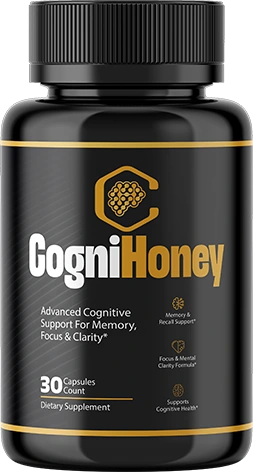
The CogniHoney facts at a glance
Twelve lines, from the capsule count to the lot reference. Those marked arithmetic are worked from the printed count and the two-capsule serving.
- Form
- Capsule
- Capsules per bottle
- 30, printed as “30 Capsules Count”
- Serving
- 2 capsules, once a day, as the label directs
- Servings per bottle
- 15, by arithmetic
- Days per bottle
- 15 at two capsules a day, by arithmetic
- Directions
- With a full glass of water, about 30 to 60 minutes before the largest meal
- Named ingredients
- 11, on the CogniHoney ingredient list
- Listed percentages
- 4: bacopa 20%, lutein 5%, zeaxanthin 5%, green tea extract 50%
- Front-label claims
- Memory & recall, focus & mental clarity, cognitive health
- Who it is for
- Adults, 18 and over
- Lot on file
- COG-26/CO-2321
- CoA reference
- COG-2321-26-CO
The eleven names on the CogniHoney list
The CogniHoney ingredient list in its own order, with each percentage and the form word each name carries.
| # | Name | Listed with | Form the name gives | Group |
|---|---|---|---|---|
| 1 | Himalayan pink salt | Name | Mineral salt | Mineral |
| 2 | Cinnamon extract | Name | Bark extract | Botanical |
| 3 | AGP choline | Name | Choline compound | Memory research |
| 4 | Bacopa monnieri | 20% | Herb, listed as 20% | Memory research |
| 5 | Lutein | 5% | Carotenoid, listed as 5% | Carotenoid |
| 6 | Bilberry leaf powder | Name | Leaf powder | Botanical |
| 7 | Vitamin B6 | Name | Vitamin | B vitamin |
| 8 | Ginkgo biloba powder | Name | Leaf powder | Botanical |
| 9 | Vitamin B12 | Name | Vitamin | B vitamin |
| 10 | Zeaxanthin | 5% | Carotenoid, listed as 5% | Carotenoid |
| 11 | Green tea extract | 50% | Extract, listed as 50% | Botanical |
Six of the eleven are photographed in the “Inside CogniHoney” image; the ingredients page describes every one.
What the CogniHoney bottle and its artwork say
The bottle is black with gold bands, and its front carries four lines of type:
- CogniHoney
- Advanced Cognitive Support For Memory, Focus & Clarity
- 30 Capsules Count
- Dietary Supplement
Beside them sit three small claim icons: Memory & Recall Support, Focus & Mental Clarity Formula and Supports Cognitive Health. The artwork marks each claim with a reference symbol that points to the standard FDA statement; this website prints that statement in full at the foot of every page instead.
The gold hexagon above the name holds a small patch of honeycomb and a C, the brand’s mark. Honey is not one of the eleven named ingredients. The name, the honeycomb mark on the label and the honey jar in the product photograph all point at honey; the ingredient list does not include it. The longer reading is in is there honey in CogniHoney?
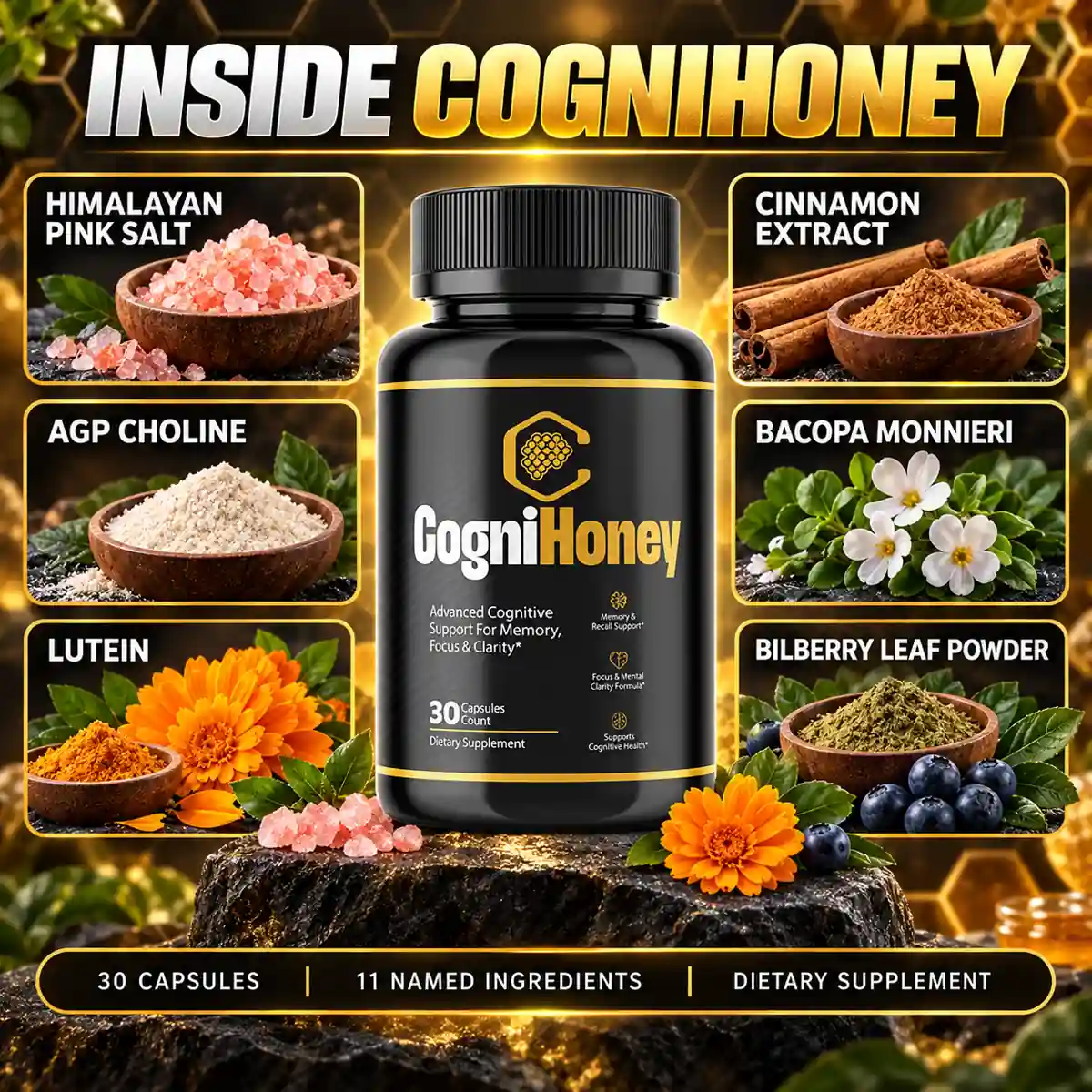
What the CogniHoney named list leaves for you to judge
What the named list does not give, and what that changes for a buyer.
What the named list gives, and where it stops
Names, without milligrams. The CogniHoney list names eleven ingredients and gives no milligram figure for any of them. The four percentages say how an extract was standardised, not how much of it a capsule holds.
Amounts belong on the panel. The CogniHoney bottle front prints the name, the three claim icons, 30 Capsules Count and Dietary Supplement. Per-serving amounts go on the Supplement Facts panel that US rules require on a supplement bottle, so read that panel on the bottle you receive, line by line, against the eleven names below.
Markers left unnamed. A percentage normally belongs to a named marker compound. The list gives the figure and not the marker, so no marker compound is named for it here.
What that means for a CogniHoney buyer
Research amounts stay apart. They cannot be set beside the capsule’s own, so every study amount on this website sits in a column of its own and is named with its study.
Intake plans cannot count it. Vitamin B6 and B12 cannot be counted toward a daily intake plan, and the sodium from pink salt and the caffeine from green tea cannot be sized.
The bottle outranks the website. If a panel is printed on the bottle you receive, it wins. Photograph it and keep it with the order email.
Research amounts beside the CogniHoney list
What published research used for each name, from the studies themselves, in a column that never becomes a claim about the capsule.
| Named on the list | What published research used | What the CogniHoney list gives |
|---|---|---|
| Himalayan pink salt | Salt, mostly sodium chloride. In an analysis of 31 pink salts, more than 30 g a day would be needed for the minerals to matter, far past the 2,300 mg sodium Daily Value. [Fayet-Moore 2020] [the FDA's guide to sodium in your diet] | Name only |
| Cinnamon extract | Trialled for blood sugar, not memory: 120 mg to 6 g a day for 4 to 18 weeks in type 2 diabetes lowered fasting glucose. [Allen 2013] [NCCIH's cinnamon fact sheet] | Name only |
| AGP choline | 250 or 500 mg a day for 7 days in 48 healthy young men raised serum free choline. Choline upper limit: 3,500 mg a day. [Marcus 2017] [the NIH Office of Dietary Supplements fact sheet on choline] | Name only |
| Bacopa monnieri | 300 to 450 mg of extract a day for 12 weeks in every trial of the systematic review; improved memory free recall. [Pase 2012] [Kongkeaw 2014] | Name, listed as 20% |
| Lutein | 12 mg of lutein and zeaxanthin combined in older adults; a year of daily use in adults aged 18 to 30; 10 mg lutein with 2 mg zeaxanthin for 5 years in AREDS2. [Hammond 2017] [Renzi-Hammond 2017] | Name, listed as 5% |
| Bilberry leaf powder | No cognition trials. Bilberry fruit extract has been used safely up to 160 mg a day; the leaves may be unsafe in high doses or for long periods. [NCCIH's bilberry fact sheet] | Name only |
| Vitamin B6 | Adult RDA 1.3 to 1.7 mg; upper limit 100 mg a day. Cognition trials of 20 and 75 mg found no short-term benefit. [the NIH Office of Dietary Supplements fact sheet on vitamin B6] [the Cochrane review of vitamin B6 and cognition] | Name only |
| Ginkgo biloba powder | 120 mg of extract twice a day for a median 6.1 years in 3,069 older adults did not reduce dementia or slow decline. [the GEM trial of ginkgo and dementia] [the GEM trial of ginkgo and cognitive decline] | Name only |
| Vitamin B12 | Adult intakes 2.4 to 2.8 mcg a day. Trials in dementia with low B12 found no cognitive effect. [the NIH Office of Dietary Supplements fact sheet on vitamin B12] [the Cochrane review of vitamin B12 and cognition] | Name only |
| Zeaxanthin | Given with lutein: 2 mg alongside 10 mg lutein in AREDS2, which found no effect on cognition over 5 years in older adults. [the AREDS2 cognitive-function trial] [the AREDS2 macular degeneration trial] | Name, listed as 5% |
| Green tea extract | Cognition effects came from caffeine and L-theanine together. Liver case reports sit at 140 to about 1,000 mg EGCG a day. [Mancini 2017] [the USP review of green tea extract and the liver] | Name, listed as 50% |
Column two is published research, each figure with its own study; column three is what the CogniHoney list gives: the name, and for four names a percentage.
How to read the CogniHoney bottle you receive
Four steps, five minutes, the day the parcel arrives.
Turn the bottle over
The lot and best-before sit on the base when the bottle shows them. Photograph both the day it arrives.
Compare the lot
The reference this desk files is lot COG-26/CO-2321, certificate-of-analysis reference COG-2321-26-CO. A different lot is not a fault; it means a different batch.
Read the bottle’s own label
The front prints the 30-capsule count. If the back or side prints a panel, check its names and serving against this page.
Match it to the order
Order support on +1 (302) 200-3480 can match a bottle to an order ID for tracking, changes and refunds.
CogniHoney supplement facts questions
How many capsules are in a bottle of CogniHoney?
Thirty. The front label reads “30 Capsules Count”, and the serving is two capsules once a day, so one bottle is 15 servings and lasts 15 days. Two bottles last 30 days, three last 45 and six last 90.
What does the 20% beside bacopa monnieri mean?
It is a standardisation figure: the extract is made so that a set share of it is a chosen marker compound, and every batch matches the last. This website prints it exactly as the list does. Lutein and zeaxanthin carry 5% and green tea extract 50% in the same way.
What do the three icons on the CogniHoney bottle say?
Memory & Recall Support, Focus & Mental Clarity Formula, and Supports Cognitive Health. They are the three supports CogniHoney names for the capsule, and they are the ceiling for everything this website says about what it is for.
How this CogniHoney supplement facts page is written
Four things a sceptical reader can check in ten minutes:
- Each fact names its source. The capsule count and the three claims are printed on the bottle front. The eleven names come from the CogniHoney ingredient list and the product photographs, and the serving from the label directions. Prices and the guarantee are CogniHoney’s own terms, as listed on 21 September 2026.
- Research amounts live in a column of their own, headed “What published research used”, beside a column that says what the list gives. No sentence here moves a number from the first into the second.
- Every study is cited against its own population. A trial in older adults, or in people with a diagnosis, is described as exactly that.
- Corrections change the date. Write to contact@Cogniqhoney.com and the review date moves forward.
We earn when you buy. Cogniqhoney is the USA Authorized CogniHoney Retailer named at the top of this page and this website makes money on orders placed through it. That is why the safety notes, the three-star review and the plain statement that CogniHoney is not a treatment for anything are on the page: they are where our interest and yours pull apart. Order support on +1 (302) 200-3480 handles tracking, changes and refunds and is never a way to place an order.
Sources for the CogniHoney supplement facts page
- Fayet-Moore F, Wibisono C, Carr P, Duve E, Petocz P, Lancaster G, McMillan J, Marshall S, Blumfield M. An Analysis of the Mineral Composition of Pink Salt Available in Australia. Foods. 2020;9(10):1490. PMID 33086585. https://pubmed.ncbi.nlm.nih.gov/33086585/
- U.S. Food and Drug Administration. Sodium in Your Diet. https://www.fda.gov/food/nutrition-education-resources-materials/sodium-your-diet
- Allen RW, Schwartzman E, Baker WL, Coleman CI, Phung OJ. Cinnamon use in type 2 diabetes: an updated systematic review and meta-analysis. Ann Fam Med. 2013;11(5):452-9. PMID 24019277. https://pubmed.ncbi.nlm.nih.gov/24019277/
- National Center for Complementary and Integrative Health, National Institutes of Health. Cinnamon. https://www.nccih.nih.gov/health/cinnamon
- Marcus L, Soileau J, Judge LW, Bellar D. Evaluation of the effects of two doses of alpha glycerylphosphorylcholine on physical and psychomotor performance. J Int Soc Sports Nutr. 2017;14:39. PMID 29042830. https://pubmed.ncbi.nlm.nih.gov/29042830/
- NIH Office of Dietary Supplements. Choline: Fact Sheet for Health Professionals. https://ods.od.nih.gov/factsheets/Choline-HealthProfessional/
- Pase MP, Kean J, Sarris J, Neale C, Scholey AB, Stough C. The cognitive-enhancing effects of Bacopa monnieri: a systematic review of randomized, controlled human clinical trials. J Altern Complement Med. 2012;18(7):647-52. PMID 22747190. https://pubmed.ncbi.nlm.nih.gov/22747190/
- Kongkeaw C, Dilokthornsakul P, Thanarangsarit P, Limpeanchob N, Norman Scholfield C. Meta-analysis of randomized controlled trials on cognitive effects of Bacopa monnieri extract. J Ethnopharmacol. 2014;151(1):528-35. PMID 24252493. https://pubmed.ncbi.nlm.nih.gov/24252493/
- Hammond BR Jr, Miller LS, Bello MO, Lindbergh CA, Mewborn C, Renzi-Hammond LM. Effects of Lutein/Zeaxanthin Supplementation on the Cognitive Function of Community Dwelling Older Adults: A Randomized, Double-Masked, Placebo-Controlled Trial. Front Aging Neurosci. 2017;9:254. PMID 28824416. https://pubmed.ncbi.nlm.nih.gov/28824416/
- Renzi-Hammond LM, Bovier ER, Fletcher LM, Miller LS, Mewborn CM, Lindbergh CA, Baxter JH, Hammond BR. Effects of a Lutein and Zeaxanthin Intervention on Cognitive Function: A Randomized, Double-Masked, Placebo-Controlled Trial of Younger Healthy Adults. Nutrients. 2017;9(11):1246. PMID 29135938. https://pubmed.ncbi.nlm.nih.gov/29135938/
- Chew EY, Clemons TE, Agrón E, Launer LJ, Grodstein F, Bernstein PS; Age-Related Eye Disease Study 2 (AREDS2) Research Group. Effect of Omega-3 Fatty Acids, Lutein/Zeaxanthin, or Other Nutrient Supplementation on Cognitive Function: The AREDS2 Randomized Clinical Trial. JAMA. 2015;314(8):791-801. PMID 26305649. https://pubmed.ncbi.nlm.nih.gov/26305649/
- Age-Related Eye Disease Study 2 Research Group. Lutein + zeaxanthin and omega-3 fatty acids for age-related macular degeneration: the Age-Related Eye Disease Study 2 (AREDS2) randomized clinical trial. JAMA. 2013;309(19):2005-15. PMID 23644932. https://pubmed.ncbi.nlm.nih.gov/23644932/
- National Center for Complementary and Integrative Health, National Institutes of Health. Bilberry. https://www.nccih.nih.gov/health/bilberry
- NIH Office of Dietary Supplements. Vitamin B6: Fact Sheet for Health Professionals. https://ods.od.nih.gov/factsheets/VitaminB6-HealthProfessional/
- Malouf R, Grimley Evans J. The effect of vitamin B6 on cognition. Cochrane Database Syst Rev. 2003;(4):CD004393. PMID 14584010. https://pubmed.ncbi.nlm.nih.gov/14584010/
- DeKosky ST, Williamson JD, Fitzpatrick AL, Kronmal RA, Ives DG, Saxton JA, Lopez OL, Burke G, Carlson MC, Fried LP, Kuller LH, Robbins JA, Tracy RP, Woolard NF, Dunn L, Snitz BE, Nahin RL, Furberg CD; Ginkgo Evaluation of Memory (GEM) Study Investigators. Ginkgo biloba for prevention of dementia: a randomized controlled trial. JAMA. 2008;300(19):2253-62. PMID 19017911. https://pubmed.ncbi.nlm.nih.gov/19017911/
- Snitz BE, O'Meara ES, Carlson MC, Arnold AM, Ives DG, Rapp SR, Saxton J, Lopez OL, Dunn LO, Sink KM, DeKosky ST; Ginkgo Evaluation of Memory (GEM) Study Investigators. Ginkgo biloba for preventing cognitive decline in older adults: a randomized trial. JAMA. 2009;302(24):2663-70. PMID 20040554. https://pubmed.ncbi.nlm.nih.gov/20040554/
- NIH Office of Dietary Supplements. Vitamin B12: Fact Sheet for Health Professionals. https://ods.od.nih.gov/factsheets/VitaminB12-HealthProfessional/
- Malouf R, Areosa Sastre A. Vitamin B12 for cognition. Cochrane Database Syst Rev. 2003;(3):CD004326. PMID 12918012. Updated 2009 (CD004326.pub2). https://pubmed.ncbi.nlm.nih.gov/12918012/
- Mancini E, Beglinger C, Drewe J, Zanchi D, Lang UE, Borgwardt S. Green tea effects on cognition, mood and human brain function: A systematic review. Phytomedicine. 2017;34:26-37. PMID 28899506. https://pubmed.ncbi.nlm.nih.gov/28899506/
- Oketch-Rabah HA, Roe AL, Rider CV, Bonkovsky HL, Giancaspro GI, Navarro V, Paine MF, Betz JM, Marles RJ, Casper S, Gurley B, Jordan SA, He K, Kapoor MP, Rao TP, Sherker AH, Fontana RJ, Rossi S, Vuppalanchi R, Seeff LB, Stolz A, Ahmad J, Koh C, Serrano J, Low Dog T, Ko R. United States Pharmacopeia (USP) comprehensive review of the hepatotoxicity of green tea extracts. Toxicol Rep. 2020;7:386-402. PMID 32140423. https://pubmed.ncbi.nlm.nih.gov/32140423/
Order CogniHoney: 30 capsules, 15 days a bottle
Two capsules a day, eleven names on the list, and 60 days from purchase to ask for a refund.
$49 to $79 a bottle across the 2, 3 and 6 bottle packs · 60 days from purchase to ask for a refund
Lot COG-26/CO-2321 · ships from the US with tracking · order support +1 (302) 200-3480