CogniHoney Official Website Memory Supplement Guide
Memory Supplement Guide: What The Research On Common Ingredients Found
Memory supplements are sold as dietary supplements, so a label may claim to support memory but not to treat any condition, and the FDA does not review them before sale. The research is uneven: bacopa has twelve-week trials with modest recall gains, ginkgo’s largest trial found no protection in older adults, and the B-vitamin reviews found no short-term benefit.
This guide covers the rules, six ingredient families, trial lengths, populations and the interactions to check.
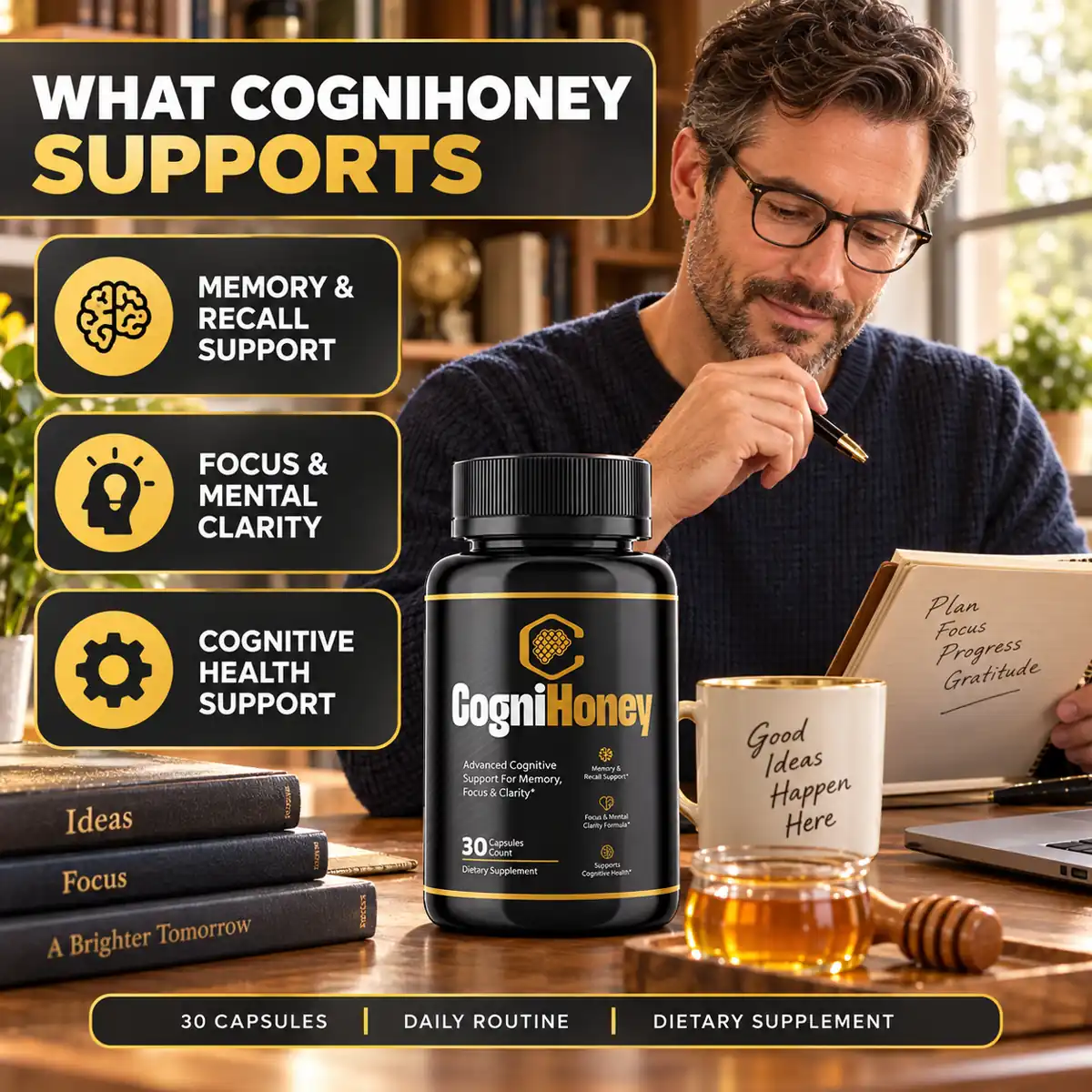
What a memory supplement is allowed to say
Three rules shape every word on a memory supplement label.
A support claim, not a cure
Labels may make structure/function claims such as “supports memory and recall”. The FDA’s page on label claims explains they are not subject to premarket review; a claim to treat or prevent a disease is reserved for drugs.
No review before sale
MedlinePlus sets out the basic position: a supplement reaches the shelf without the premarket testing a drug goes through, which is why every label carries the FDA statement.
An evidence bar for adverts
The FTC’s guidance on health products expects health claims in advertising to rest on competent and reliable scientific evidence. A review or a testimonial does not meet it.
“Supports memory” on a label tells you what the product is for, not what it has been shown to do. And NCCIH’s summary for this category is blunt about the ceiling: direct evidence that any dietary supplement can prevent Alzheimer’s disease or other dementia is lacking.
The six ingredient families on memory labels
Most memory labels mix several of these, and the family tells you what kind of evidence to expect.
Traditional herbs
Bacopa monnieri and ginkgo biloba. The two with the longest trial records in this category, and two very different sets of results.
Choline sources
Alpha-GPC, sometimes listed as AGP choline. A choline compound the body can use toward acetylcholine, a messenger involved in memory.
Carotenoids
Lutein and zeaxanthin, best known for the eye. A 2014 review notes that lutein is the predominant carotenoid in human brain tissue.
B vitamins
Vitamins B6 and B12, needed for nerve function and for making neurotransmitters. The question is whether more helps people who already have enough.
Caffeine-bearing botanicals
Green tea extract. Its short-term effects on attention trace mostly to caffeine and L-theanine working together.
Supporting ingredients
Cinnamon, bilberry leaf and mineral salt appear on some labels. Their research is mostly about other things, such as blood sugar.
What the research found, ingredient by ingredient
Seven ingredients, the research most often cited for each, and what it found in the people it studied.
| Ingredient | Key research | Who was studied | How long | What was found |
|---|---|---|---|---|
| Bacopa monnieri | Pase 2012; Kongkeaw 2014 | Adults in six trials; 518 people across nine | 12 weeks | Improved 9 of 17 free-recall tests; faster Trail B and choice reaction time |
| Ginkgo biloba | GEM 2008; Laws 2012 | 3,069 adults aged 75 and over; healthy people | Median 6.1 years | No reduction in dementia (HR 1.12); effect sizes near zero in healthy people |
| Lutein and zeaxanthin | Renzi-Hammond 2017; AREDS2 2015 | Adults aged 18 to 30; 3,501 older adults with macular degeneration | 1 year; 5 years | Better spatial memory and complex attention in the young adults; no effect on cognition in AREDS2 |
| Alpha-GPC | Marcus 2017; Lee 2021 | 48 healthy young men; about 12 million adults aged 50 and over | 7 days; 10 years of records | Raised serum choline; prescribed use associated with higher stroke risk (HR 1.43) |
| Vitamin B6 | Cochrane review | 109 healthy older people in two trials | 5 and 12 weeks | No short-term benefit for cognition or mood |
| Vitamin B12 | Cochrane review | People with dementia and low B12 | Two small trials | No significant effect on cognition |
| Green tea | Mancini 2017 | 21 studies, mixed populations | Mostly single doses | Memory and attention effects with caffeine and L-theanine together, less with either alone |
Each figure is what the paper reports, in the people it studied. None of them describes a finished product.
Why trial length matters more than most label numbers
How long the research behind an ingredient ran decides whether your own test of it is a fair one.
-
7 days
Alpha-GPC in young men
Marcus 2017 gave 250 or 500 mg a day for a week and measured serum choline and physical performance. A sports study, not a memory one.
-
5 weeks
Vitamin B6 at 75 mg
One of the two trials in the Cochrane review. No short-term benefit.
-
12 weeks
Every bacopa trial in the systematic review
All six trials in Pase 2012 ran twelve weeks, as did the trial in adults over 65, which improved delayed word recall.
-
1 year
Lutein and zeaxanthin in adults aged 18 to 30
Renzi-Hammond 2017: better spatial memory, reasoning and complex attention.
-
5 years
AREDS2
10 mg lutein with 2 mg zeaxanthin in older adults with macular degeneration: no effect on cognitive function.
-
6.1 years
GEM, ginkgo
Median follow-up of 3,069 adults aged 75 and over on 120 mg twice a day. No slowing of decline in any domain, memory included.
A trial that found something at twelve weeks says nothing about week two. Match the length of your own test to the length of the research, and decide how you will judge it before you start.
Reading a study against its population
The same capsule can be tested in a 25-year-old student and an 80-year-old with a diagnosis. The result belongs to the people who took part.
Healthy young adults
Renzi-Hammond 2017 (ages 18 to 30) and Marcus 2017 (college-aged men). Their results say most about people like them.
Healthy older adults
Calabrese 2008 (over 65, no dementia), Hammond 2017 (mean age 73.7) and GEM (75 and over). The group most memory supplements are sold to.
People with a diagnosis
AREDS2 enrolled people with macular degeneration; the Cochrane B12 trials, people with dementia and low B12. Their results do not transfer to a healthy buyer, in either direction.
Four numbers worth remembering
Interactions worth checking before you start
Each caution comes from the source beside it, and each matters to anyone taking the medicine it names.
| Ingredient | The caution | Source |
|---|---|---|
| Ginkgo | May add to bleeding risk with anticoagulants such as warfarin | NCCIH; Bent 2005 |
| Cinnamon | Lowered fasting glucose in type 2 diabetes, the same direction as diabetes medicine | Allen 2013 |
| Cassia cinnamon | Coumarin, linked to liver effects | NCCIH; Abraham 2010 |
| Green tea extract | Rare liver injury, mostly with extracts in capsules; the USP advises taking it with food | USP review; EFSA |
| Green tea | Lowers blood levels of nadolol and atorvastatin | NCCIH |
| Alpha-GPC | Prescribed use associated with higher ten-year stroke risk | Lee 2021 |
| Vitamin B12 | Metformin and acid reducers lower B12 over time | ODS; Aroda 2016 |
| Vitamin B6 | High intakes linked to sensory neuropathy; upper limit 100 mg a day | ODS |
Directions of effect from the cited sources. How much a given capsule matters depends on how much of each ingredient it holds.
NCCIH’s explainer on interactions makes the general point: a supplement can raise, lower or change the effect of a medicine, so your prescriber needs the full list. Take the bottle, not a screenshot of an advert.
What else supports memory
A supplement is one line on a longer list. These are the others.
Physical activity
Regular movement is one of the everyday factors the National Institute on Aging lists for cognitive health.
Blood pressure
Keeping blood pressure in range protects the brain as well as the heart.
Sleep
Memory is consolidated during sleep; a short night shows up the next day.
Staying connected
Social contact and new learning keep the mind in use.
Reviewing medicines
Some medicines affect memory. A regular review with a prescriber catches them.
Food and alcohol
A varied diet and moderate alcohol are part of the same picture.
The National Institute on Aging’s page on cognitive health sets these out in more detail. None of them comes in a bottle, and most of them cost nothing.
When memory change needs more than a supplement
Forgetting a name and recalling it later is ordinary. Getting lost somewhere familiar, repeating the same question within minutes, or struggling with tasks that used to be routine is different. That kind of change is a reason to be assessed by a clinician, soon, and not a reason to start a capsule. Some causes of memory trouble, such as a low B12 level or a medicine side effect, are treatable once found.
Where CogniHoney fits in this picture
One label, read with the guide
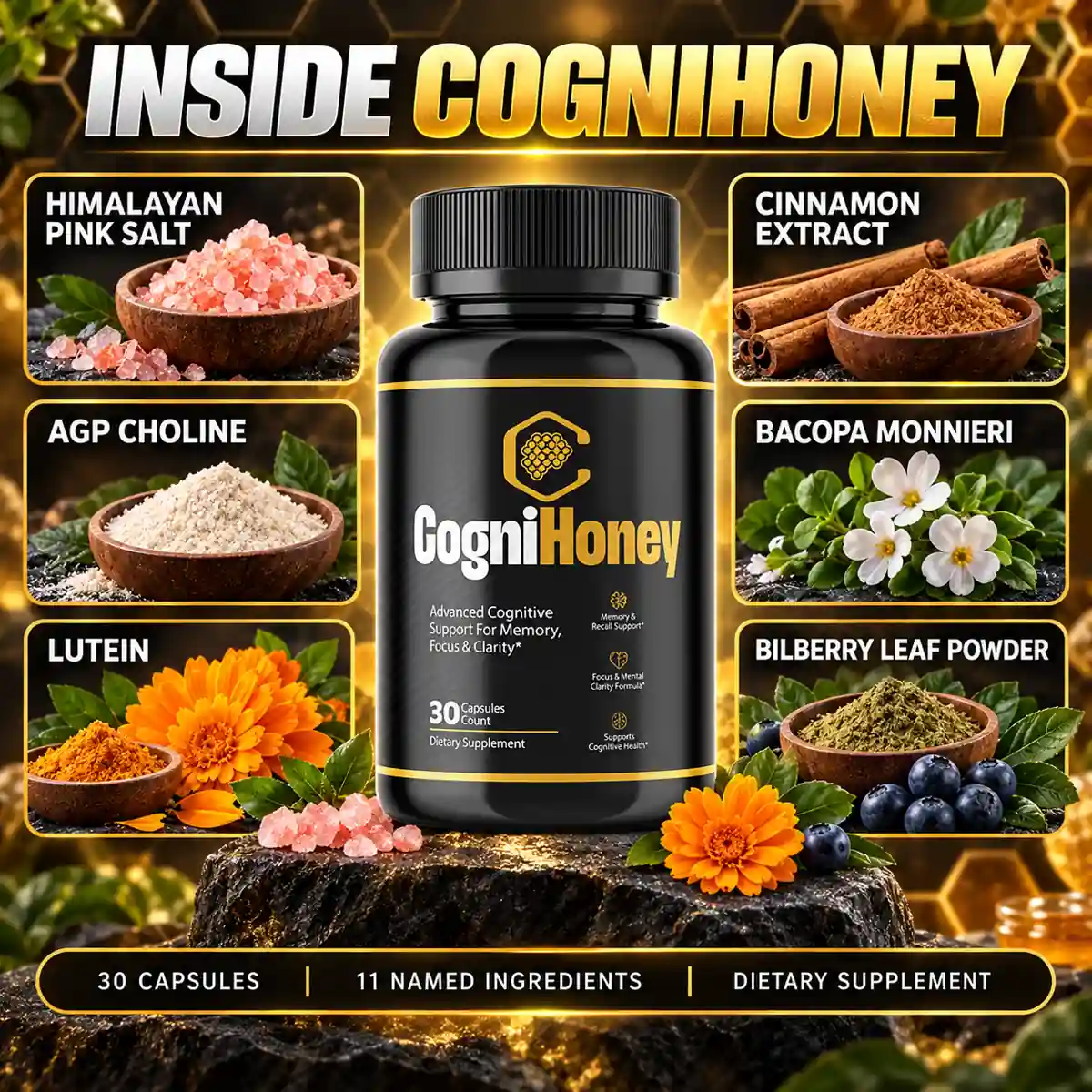
CogniHoney names eleven ingredients drawn from all six families above: bacopa monnieri (listed as 20%) and ginkgo biloba powder; AGP choline; lutein and zeaxanthin (5% each); vitamins B6 and B12; green tea extract (50%); and cinnamon extract, bilberry leaf powder and Himalayan pink salt.
Read it with this guide open. The supplement facts page shows exactly what the list gives, the safety page applies the interactions table to it, and the companion guide scores it against a ten-point checklist, lost points included.
Who wrote this guide
Four things a sceptical reader can check in ten minutes:
- Each fact names its source. The capsule count and the three claims are printed on the bottle front. The eleven names come from the CogniHoney ingredient list and the product photographs, and the serving from the label directions. Prices and the guarantee are CogniHoney’s own terms, as listed on 21 September 2026.
- Research amounts live in a column of their own, headed “What published research used”, beside a column that says what the list gives. No sentence here moves a number from the first into the second.
- Every study is cited against its own population. A trial in older adults, or in people with a diagnosis, is described as exactly that.
- Corrections change the date. Write to contact@Cogniqhoney.com and the review date moves forward.
We earn when you buy. Cogniqhoney is the USA Authorized CogniHoney Retailer named at the top of this page and this website makes money on orders placed through it. That is why the safety notes, the three-star review and the plain statement that CogniHoney is not a treatment for anything are on the page: they are where our interest and yours pull apart. Order support on +1 (302) 200-3480 handles tracking, changes and refunds and is never a way to place an order.
Sources cited in this guide
- Allen RW, Schwartzman E, Baker WL, Coleman CI, Phung OJ. Cinnamon use in type 2 diabetes: an updated systematic review and meta-analysis. Ann Fam Med. 2013;11(5):452-9. PMID 24019277. https://pubmed.ncbi.nlm.nih.gov/24019277/
- Abraham K, Wöhrlin F, Lindtner O, Heinemeyer G, Lampen A. Toxicology and risk assessment of coumarin: focus on human data. Mol Nutr Food Res. 2010;54(2):228-39. PMID 20024932. https://pubmed.ncbi.nlm.nih.gov/20024932/
- National Center for Complementary and Integrative Health, National Institutes of Health. Cinnamon. https://www.nccih.nih.gov/health/cinnamon
- Marcus L, Soileau J, Judge LW, Bellar D. Evaluation of the effects of two doses of alpha glycerylphosphorylcholine on physical and psychomotor performance. J Int Soc Sports Nutr. 2017;14:39. PMID 29042830. https://pubmed.ncbi.nlm.nih.gov/29042830/
- Lee G, Choi S, Chang J, Choi D, Son JS, Kim K, Kim SM, Jeong S, Park SM. Association of L-α Glycerylphosphorylcholine With Subsequent Stroke Risk After 10 Years. JAMA Netw Open. 2021;4(11):e2136008. PMID 34817582. https://pubmed.ncbi.nlm.nih.gov/34817582/
- Pase MP, Kean J, Sarris J, Neale C, Scholey AB, Stough C. The cognitive-enhancing effects of Bacopa monnieri: a systematic review of randomized, controlled human clinical trials. J Altern Complement Med. 2012;18(7):647-52. PMID 22747190. https://pubmed.ncbi.nlm.nih.gov/22747190/
- Kongkeaw C, Dilokthornsakul P, Thanarangsarit P, Limpeanchob N, Norman Scholfield C. Meta-analysis of randomized controlled trials on cognitive effects of Bacopa monnieri extract. J Ethnopharmacol. 2014;151(1):528-35. PMID 24252493. https://pubmed.ncbi.nlm.nih.gov/24252493/
- Calabrese C, Gregory WL, Leo M, Kraemer D, Bone K, Oken B. Effects of a standardized Bacopa monnieri extract on cognitive performance, anxiety, and depression in the elderly: a randomized, double-blind, placebo-controlled trial. J Altern Complement Med. 2008;14(6):707-13. PMID 18611150. https://pubmed.ncbi.nlm.nih.gov/18611150/
- Hammond BR Jr, Miller LS, Bello MO, Lindbergh CA, Mewborn C, Renzi-Hammond LM. Effects of Lutein/Zeaxanthin Supplementation on the Cognitive Function of Community Dwelling Older Adults: A Randomized, Double-Masked, Placebo-Controlled Trial. Front Aging Neurosci. 2017;9:254. PMID 28824416. https://pubmed.ncbi.nlm.nih.gov/28824416/
- Renzi-Hammond LM, Bovier ER, Fletcher LM, Miller LS, Mewborn CM, Lindbergh CA, Baxter JH, Hammond BR. Effects of a Lutein and Zeaxanthin Intervention on Cognitive Function: A Randomized, Double-Masked, Placebo-Controlled Trial of Younger Healthy Adults. Nutrients. 2017;9(11):1246. PMID 29135938. https://pubmed.ncbi.nlm.nih.gov/29135938/
- Chew EY, Clemons TE, Agrón E, Launer LJ, Grodstein F, Bernstein PS; Age-Related Eye Disease Study 2 (AREDS2) Research Group. Effect of Omega-3 Fatty Acids, Lutein/Zeaxanthin, or Other Nutrient Supplementation on Cognitive Function: The AREDS2 Randomized Clinical Trial. JAMA. 2015;314(8):791-801. PMID 26305649. https://pubmed.ncbi.nlm.nih.gov/26305649/
- Johnson EJ. Role of lutein and zeaxanthin in visual and cognitive function throughout the lifespan. Nutr Rev. 2014;72(9):605-12. PMID 25109868. https://pubmed.ncbi.nlm.nih.gov/25109868/
- NIH Office of Dietary Supplements. Vitamin B6: Fact Sheet for Health Professionals. https://ods.od.nih.gov/factsheets/VitaminB6-HealthProfessional/
- Malouf R, Grimley Evans J. The effect of vitamin B6 on cognition. Cochrane Database Syst Rev. 2003;(4):CD004393. PMID 14584010. https://pubmed.ncbi.nlm.nih.gov/14584010/
- DeKosky ST, Williamson JD, Fitzpatrick AL, Kronmal RA, Ives DG, Saxton JA, Lopez OL, Burke G, Carlson MC, Fried LP, Kuller LH, Robbins JA, Tracy RP, Woolard NF, Dunn L, Snitz BE, Nahin RL, Furberg CD; Ginkgo Evaluation of Memory (GEM) Study Investigators. Ginkgo biloba for prevention of dementia: a randomized controlled trial. JAMA. 2008;300(19):2253-62. PMID 19017911. https://pubmed.ncbi.nlm.nih.gov/19017911/
- Snitz BE, O'Meara ES, Carlson MC, Arnold AM, Ives DG, Rapp SR, Saxton J, Lopez OL, Dunn LO, Sink KM, DeKosky ST; Ginkgo Evaluation of Memory (GEM) Study Investigators. Ginkgo biloba for preventing cognitive decline in older adults: a randomized trial. JAMA. 2009;302(24):2663-70. PMID 20040554. https://pubmed.ncbi.nlm.nih.gov/20040554/
- Laws KR, Sweetnam H, Kondel TK. Is Ginkgo biloba a cognitive enhancer in healthy individuals? A meta-analysis. Hum Psychopharmacol. 2012;27(6):527-33. PMID 23001963. https://pubmed.ncbi.nlm.nih.gov/23001963/
- Bent S, Goldberg H, Padula A, Avins AL. Spontaneous bleeding associated with ginkgo biloba: a case report and systematic review of the literature. J Gen Intern Med. 2005;20(7):657-61. PMID 16050865. https://pubmed.ncbi.nlm.nih.gov/16050865/
- National Center for Complementary and Integrative Health, National Institutes of Health. Ginkgo. https://www.nccih.nih.gov/health/ginkgo
- NIH Office of Dietary Supplements. Vitamin B12: Fact Sheet for Health Professionals. https://ods.od.nih.gov/factsheets/VitaminB12-HealthProfessional/
- Malouf R, Areosa Sastre A. Vitamin B12 for cognition. Cochrane Database Syst Rev. 2003;(3):CD004326. PMID 12918012. Updated 2009 (CD004326.pub2). https://pubmed.ncbi.nlm.nih.gov/12918012/
- Aroda VR, Edelstein SL, Goldberg RB, Knowler WC, Marcovina SM, Orchard TJ, Bray GA, Schade DS, Temprosa MG, White NH, Crandall JP; Diabetes Prevention Program Research Group. Long-term Metformin Use and Vitamin B12 Deficiency in the Diabetes Prevention Program Outcomes Study. J Clin Endocrinol Metab. 2016;101(4):1754-61. PMID 26900641. https://pubmed.ncbi.nlm.nih.gov/26900641/
- Mancini E, Beglinger C, Drewe J, Zanchi D, Lang UE, Borgwardt S. Green tea effects on cognition, mood and human brain function: A systematic review. Phytomedicine. 2017;34:26-37. PMID 28899506. https://pubmed.ncbi.nlm.nih.gov/28899506/
- Oketch-Rabah HA, Roe AL, Rider CV, Bonkovsky HL, Giancaspro GI, Navarro V, Paine MF, Betz JM, Marles RJ, Casper S, Gurley B, Jordan SA, He K, Kapoor MP, Rao TP, Sherker AH, Fontana RJ, Rossi S, Vuppalanchi R, Seeff LB, Stolz A, Ahmad J, Koh C, Serrano J, Low Dog T, Ko R. United States Pharmacopeia (USP) comprehensive review of the hepatotoxicity of green tea extracts. Toxicol Rep. 2020;7:386-402. PMID 32140423. https://pubmed.ncbi.nlm.nih.gov/32140423/
- European Food Safety Authority. EFSA assesses safety of green tea catechins. News release on the Panel on Food Additives and Nutrient Sources opinion, EFSA Journal 2018;16(4):5239. https://www.efsa.europa.eu/en/press/news/180418
- National Center for Complementary and Integrative Health, National Institutes of Health. Green Tea. https://www.nccih.nih.gov/health/green-tea
- National Center for Complementary and Integrative Health, National Institutes of Health. 7 Things To Know About Dietary Supplements for Cognitive Function, Dementia, and Alzheimer's Disease. https://www.nccih.nih.gov/health/tips/things-to-know-about-dietary-supplements-for-cognitive-function-dementia-and-alzheimers-disease
- National Institute on Aging, National Institutes of Health. Cognitive Health and Older Adults. https://www.nia.nih.gov/health/brain-health/cognitive-health-and-older-adults
- National Center for Complementary and Integrative Health, National Institutes of Health. Know the Science: How Medications and Supplements Can Interact. https://www.nccih.nih.gov/health/know-science/how-medications-and-supplements-can-interact/introduction
- MedlinePlus, National Library of Medicine. Dietary Supplements. https://medlineplus.gov/dietarysupplements.html
- U.S. Food and Drug Administration. Label Claims for Conventional Foods and Dietary Supplements. https://www.fda.gov/food/nutrition-food-labeling-and-critical-foods/label-claims-conventional-foods-and-dietary-supplements
- Federal Trade Commission. Health Products Compliance Guidance. https://www.ftc.gov/business-guidance/resources/health-products-compliance-guidance
Try CogniHoney with the research in mind
Two capsules a day, fifteen days a bottle, and 60 days from purchase to ask for a refund.
$49 to $79 a bottle across the 2, 3 and 6 bottle packs · 60 days from purchase to ask for a refund
Lot COG-26/CO-2321 · ships from the US with tracking · order support +1 (302) 200-3480