CogniHoney Official Website How It Works
How CogniHoney Works: A Daily Routine Built Around Eleven Named Ingredients
CogniHoney works as a routine rather than a quick effect: two capsules once a day, with a full glass of water, 30 to 60 minutes before the largest meal. Its names act on memory through separate routes, from choline and bacopa to lutein and the B vitamins, and the bacopa memory trials all ran twelve weeks.
Below: the routine, each route, what trials in people found, and where that evidence stops.

The CogniHoney routine in three steps
Everything about how the capsule is meant to work starts with how it is taken. The label direction is short, and each part of it is there for a reason you can use.
Two capsules
One serving is two capsules, taken once a day. A bottle holds 30, so it lasts 15 days.
A full glass of water
The label directions ask for a full glass with the capsules, every time, rather than a mouthful.
30 to 60 minutes before the largest meal
Whichever meal is biggest in your day, lunch or dinner, the capsules go in half an hour to an hour before it.
Two capsules once a day is a single daily dose, which is why CogniHoney is described as a once-daily capsule. The how to take it page turns the direction into a daily schedule.
How the CogniHoney ingredients are thought to act
The eleven names do not share one mechanism. They act through separate routes, and each route has its own research, of very different depth.
Choline toward acetylcholine
AGP choline is a choline source. Choline is needed to make acetylcholine, a messenger involved in memory (ODS choline). In 48 healthy young men, alpha-GPC raised serum free choline within 7 days (Marcus 2017).
Bacopa, over weeks
Bacopa is a traditional herb whose trials measure memory after twelve weeks, not after a dose. Its effects on learning and memory were largest at the twelve-week mark (Stough 2001).
Carotenoids that reach the brain
Lutein is the predominant carotenoid in human brain tissue (Johnson 2014). Zeaxanthin travels with it in food and in the trials.
B vitamins in the background
B6 is used in making neurotransmitters (ODS B6) and B12 is needed for nerve function (ODS B12). They support the system rather than acting on memory directly.
Green tea’s pairing
A review of 21 studies found memory and attention effects when green tea’s caffeine and L-theanine worked together, and smaller effects from either alone (Mancini 2017).
The rest of the list
Ginkgo is the long-studied memory botanical; cinnamon and bilberry leaf are studied for blood sugar; pink salt is salt. Each is described with its evidence on the ingredients page.
What CogniHoney says it supports, and the names behind each claim
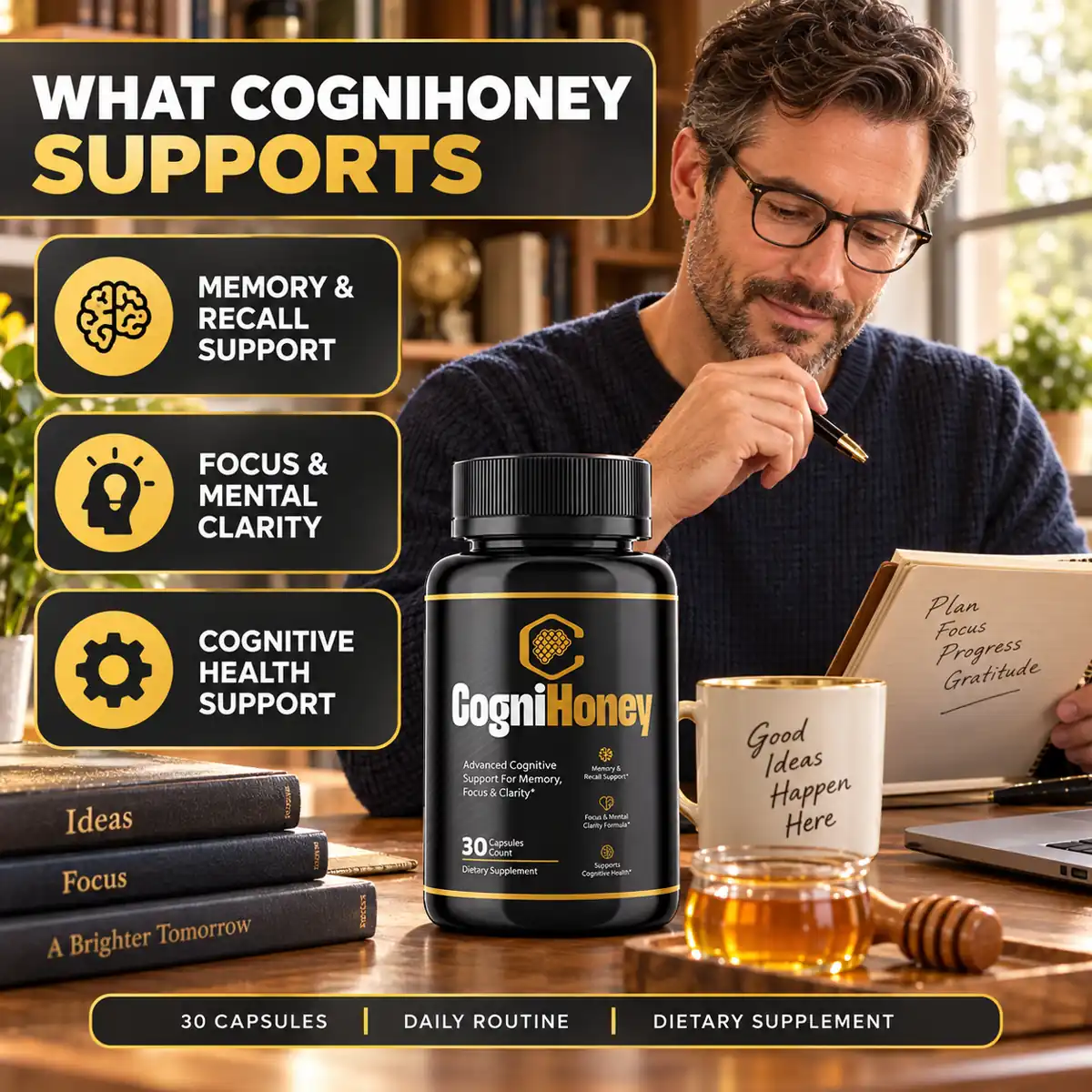
The bottle front prints three claim icons, and the “What CogniHoney Supports” photograph repeats them in three gold roundels. Each claim sits on a different group of names:
- Memory & Recall Support. Bacopa monnieri and AGP choline, with lutein and zeaxanthin in the younger-adult trial.
- Focus & Mental Clarity Formula. Green tea extract, and lutein with zeaxanthin for complex attention.
- Supports Cognitive Health. Vitamins B6 and B12, and the everyday habits the National Institute on Aging ties to cognitive health.
These are structure-function claims: a label may describe support for a normal body function without FDA review before sale, and it may not claim to treat or prevent a disease (FDA on label claims). CogniHoney makes the first kind of claim and never the second.
The benefits page takes the three claims one at a time.
Four terms that explain how CogniHoney works
The research on these ingredients leans on a handful of words. Here they are in plain English, each tied to a name on the list or to the way the capsules are taken.
Acetylcholine
A chemical messenger the nervous system uses, with a role in memory. The body builds it from choline, which is the reason a choline source, AGP choline, sits on the CogniHoney list (ODS choline).
Standardised extract
An extract made to a set share of one marker compound, so each batch matches the last. Four names carry that figure: bacopa 20%, lutein 5%, zeaxanthin 5% and green tea extract 50%.
Carotenoid
A yellow-to-red plant pigment. Lutein and zeaxanthin are two of them, and lutein is the main carotenoid found in human brain tissue (Johnson 2014).
Chronic dosing
Trial language for a daily dose taken for weeks and measured at the end, rather than hours after one dose. The bacopa memory trials worked this way (Stough 2001), and so does the CogniHoney routine.
What trials found for the routes CogniHoney uses
Four numbers that frame the research, then an honest split of what held up, what did not, and what nobody has tested.
What held up, what did not, what is still open
What held up. Bacopa over twelve weeks, on memory free recall (Pase 2012). Lutein and zeaxanthin on complex attention in older adults (Hammond 2017) and on spatial memory in adults aged 18 to 30 (Renzi-Hammond 2017).
What did not. Ginkgo did not reduce dementia or slow decline in 3,069 adults aged 75 and over (GEM). In healthy people its effects on memory were close to zero (Laws 2012).
What is still open. How eleven ingredients act together. No trial has tested this combination, and the trials above each used amounts the researchers chose. Some names have good support, some have little, and the routine is the thing to judge.
What the research behind CogniHoney does not show
A supplement page that only lists the good trials is a sales page. Here are both columns, with the studies named.
What the research supports
- Bacopa improved memory free recall in twelve-week trials (Pase 2012).
- Lutein with zeaxanthin improved complex attention and cognitive flexibility in older adults (Hammond 2017).
- Green tea’s caffeine and L-theanine together showed memory and attention effects.
- B6 and B12 have clear, measured roles in the nervous system.
What it does not show
- Ginkgo in older adults did not reduce dementia or slow cognitive decline (GEM 2009).
- B6 gave no short-term benefit for cognition in healthy older people (Cochrane B6).
- B12 trials in people with dementia found no significant effect on cognition (Cochrane B12).
- Direct evidence that any supplement prevents dementia is lacking (NCCIH).
Why CogniHoney asks for weeks, not days
The routes above work on a scale of weeks. Here is the routine laid against the calendar.
-
Day 1
The first two capsules
Nothing to feel yet. The job on day one is setting the time: half an hour to an hour before the largest meal, with a full glass of water.
-
Day 15
The first bottle runs out
Thirty capsules at two a day is 15 days. Every pack is two bottles or more, so the second bottle is already in the cupboard.
-
Weeks 4 to 8
The first reports
The window in which this desk’s buyers most often report a first change. Two four-star reviewers wanted more in week one, which fits trials measured at twelve weeks.
-
Week 12
The span the trials measured
Every bacopa trial in the 2012 review ran twelve weeks. The six-bottle pack is 90 days and is the only pack that covers it.
How CogniHoney works: questions
Does CogniHoney work straight away?
It is not built to. The bacopa trials behind the memory claim all ran twelve weeks (Pase 2012), and this desk’s own buyers most often report a first change at 4 to 8 weeks. Treat the first bottle, fifteen days, as the start of a routine rather than a test of it.
Why is CogniHoney taken before the largest meal?
That is the label direction: two capsules with a full glass of water, about 30 to 60 minutes before the largest meal, which also gives the day one fixed point to hang the habit on. One ingredient has its own timing note, green tea extract, and the safety page sets that note beside the label direction.
Has CogniHoney itself been tested in a clinical trial?
No published trial has tested CogniHoney as a finished product. The studies on this page tested single ingredients, usually at amounts the study itself chose, and each is described with the population it used.
Can I take more than two capsules to speed it up?
No. The label directions set two capsules a day, and nothing in the research on these ingredients suggests that more capsules shorten the twelve-week span. Several names on the list, vitamin B6 and choline among them, have daily upper limits for exactly this reason.
How this CogniHoney page is written
Four things a sceptical reader can check in ten minutes:
- Each fact names its source. The capsule count and the three claims are printed on the bottle front. The eleven names come from the CogniHoney ingredient list and the product photographs, and the serving from the label directions. Prices and the guarantee are CogniHoney’s own terms, as listed on 21 September 2026.
- Research amounts live in a column of their own, headed “What published research used”, beside a column that says what the list gives. No sentence here moves a number from the first into the second.
- Every study is cited against its own population. A trial in older adults, or in people with a diagnosis, is described as exactly that.
- Corrections change the date. Write to contact@Cogniqhoney.com and the review date moves forward.
We earn when you buy. Cogniqhoney is the USA Authorized CogniHoney Retailer named at the top of this page and this website makes money on orders placed through it. That is why the safety notes, the three-star review and the plain statement that CogniHoney is not a treatment for anything are on the page: they are where our interest and yours pull apart. Order support on +1 (302) 200-3480 handles tracking, changes and refunds and is never a way to place an order.
Sources for how CogniHoney works
- Marcus L, Soileau J, Judge LW, Bellar D. Evaluation of the effects of two doses of alpha glycerylphosphorylcholine on physical and psychomotor performance. J Int Soc Sports Nutr. 2017;14:39. PMID 29042830. https://pubmed.ncbi.nlm.nih.gov/29042830/
- NIH Office of Dietary Supplements. Choline: Fact Sheet for Health Professionals. https://ods.od.nih.gov/factsheets/Choline-HealthProfessional/
- Pase MP, Kean J, Sarris J, Neale C, Scholey AB, Stough C. The cognitive-enhancing effects of Bacopa monnieri: a systematic review of randomized, controlled human clinical trials. J Altern Complement Med. 2012;18(7):647-52. PMID 22747190. https://pubmed.ncbi.nlm.nih.gov/22747190/
- Stough C, Lloyd J, Clarke J, Downey LA, Hutchison CW, Rodgers T, Nathan PJ. The chronic effects of an extract of Bacopa monniera (Brahmi) on cognitive function in healthy human subjects. Psychopharmacology (Berl). 2001;156(4):481-4. PMID 11498727. Erratum: Psychopharmacology (Berl). 2015;232(13):2427. https://pubmed.ncbi.nlm.nih.gov/11498727/
- Hammond BR Jr, Miller LS, Bello MO, Lindbergh CA, Mewborn C, Renzi-Hammond LM. Effects of Lutein/Zeaxanthin Supplementation on the Cognitive Function of Community Dwelling Older Adults: A Randomized, Double-Masked, Placebo-Controlled Trial. Front Aging Neurosci. 2017;9:254. PMID 28824416. https://pubmed.ncbi.nlm.nih.gov/28824416/
- Renzi-Hammond LM, Bovier ER, Fletcher LM, Miller LS, Mewborn CM, Lindbergh CA, Baxter JH, Hammond BR. Effects of a Lutein and Zeaxanthin Intervention on Cognitive Function: A Randomized, Double-Masked, Placebo-Controlled Trial of Younger Healthy Adults. Nutrients. 2017;9(11):1246. PMID 29135938. https://pubmed.ncbi.nlm.nih.gov/29135938/
- Johnson EJ. Role of lutein and zeaxanthin in visual and cognitive function throughout the lifespan. Nutr Rev. 2014;72(9):605-12. PMID 25109868. https://pubmed.ncbi.nlm.nih.gov/25109868/
- NIH Office of Dietary Supplements. Vitamin B6: Fact Sheet for Health Professionals. https://ods.od.nih.gov/factsheets/VitaminB6-HealthProfessional/
- Malouf R, Grimley Evans J. The effect of vitamin B6 on cognition. Cochrane Database Syst Rev. 2003;(4):CD004393. PMID 14584010. https://pubmed.ncbi.nlm.nih.gov/14584010/
- DeKosky ST, Williamson JD, Fitzpatrick AL, Kronmal RA, Ives DG, Saxton JA, Lopez OL, Burke G, Carlson MC, Fried LP, Kuller LH, Robbins JA, Tracy RP, Woolard NF, Dunn L, Snitz BE, Nahin RL, Furberg CD; Ginkgo Evaluation of Memory (GEM) Study Investigators. Ginkgo biloba for prevention of dementia: a randomized controlled trial. JAMA. 2008;300(19):2253-62. PMID 19017911. https://pubmed.ncbi.nlm.nih.gov/19017911/
- Snitz BE, O'Meara ES, Carlson MC, Arnold AM, Ives DG, Rapp SR, Saxton J, Lopez OL, Dunn LO, Sink KM, DeKosky ST; Ginkgo Evaluation of Memory (GEM) Study Investigators. Ginkgo biloba for preventing cognitive decline in older adults: a randomized trial. JAMA. 2009;302(24):2663-70. PMID 20040554. https://pubmed.ncbi.nlm.nih.gov/20040554/
- Laws KR, Sweetnam H, Kondel TK. Is Ginkgo biloba a cognitive enhancer in healthy individuals? A meta-analysis. Hum Psychopharmacol. 2012;27(6):527-33. PMID 23001963. https://pubmed.ncbi.nlm.nih.gov/23001963/
- NIH Office of Dietary Supplements. Vitamin B12: Fact Sheet for Health Professionals. https://ods.od.nih.gov/factsheets/VitaminB12-HealthProfessional/
- Malouf R, Areosa Sastre A. Vitamin B12 for cognition. Cochrane Database Syst Rev. 2003;(3):CD004326. PMID 12918012. Updated 2009 (CD004326.pub2). https://pubmed.ncbi.nlm.nih.gov/12918012/
- Mancini E, Beglinger C, Drewe J, Zanchi D, Lang UE, Borgwardt S. Green tea effects on cognition, mood and human brain function: A systematic review. Phytomedicine. 2017;34:26-37. PMID 28899506. https://pubmed.ncbi.nlm.nih.gov/28899506/
- National Center for Complementary and Integrative Health, National Institutes of Health. 7 Things To Know About Dietary Supplements for Cognitive Function, Dementia, and Alzheimer's Disease. https://www.nccih.nih.gov/health/tips/things-to-know-about-dietary-supplements-for-cognitive-function-dementia-and-alzheimers-disease
- U.S. Food and Drug Administration. Label Claims for Conventional Foods and Dietary Supplements. https://www.fda.gov/food/nutrition-food-labeling-and-critical-foods/label-claims-conventional-foods-and-dietary-supplements
Start the CogniHoney routine on the official website
Two capsules a day, before the largest meal. The six-bottle pack covers the twelve weeks the bacopa trials ran.
$49 to $79 a bottle across the 2, 3 and 6 bottle packs · 60 days from purchase to ask for a refund
Lot COG-26/CO-2321 · ships from the US with tracking · order support +1 (302) 200-3480