CogniHoney Official Website Blog Bilberry Leaf, Not Bilberry Fruit
Bilberry Leaf, Not Bilberry Fruit: Reading That Line On The CogniHoney Label
CogniHoney’s label names “bilberry leaf powder,” not bilberry fruit or bilberry extract. That single word, leaf, is the whole subject of this note: most of what people have heard about bilberry — anthocyanins, eye health, wartime pilots — is research on the fruit. The leaf is a different part of the same plant, with a different, much thinner research record.
- Leaf and fruit are different parts of Vaccinium myrtillus. The anthocyanin-rich fruit is what eye-health research studied; the leaf is what CogniHoney’s label names.
- The eye-health trials tested fruit extract, and mostly failed. A systematic review of 12 placebo-controlled trials found the four most rigorous, most recent ones were all negative for night vision in healthy eyes.
- The leaf has its own, separate history: a traditional remedy for blood sugar, with modern research still asking the same question and flagging its own caution at higher doses.
- NCCIH’s caution is specifically about the leaf, not the fruit, and CogniHoney’s own supplement facts page already cites it for exactly that reason.
The short answer: leaf, not fruit
Bilberry (Vaccinium myrtillus) is a small European relative of the blueberry, and its fruit and its leaves are studied for almost entirely different reasons. The dark purple fruit is rich in anthocyanins, the pigments behind decades of research into night vision and eye health. The leaf carries a different, less-studied set of compounds and a much older, narrower folk history: a traditional remedy for blood sugar, used in European herbal medicine before insulin existed.[Ulbricht 2009]
CogniHoney’s supplement facts panel is specific about which part it uses: “bilberry leaf powder,” the sixth of eleven named ingredients, with no percentage and no eye-health claim attached to it anywhere on the label. That precision is the whole point of this note. A shopper who has only ever heard of bilberry in connection with eyesight is reading the fruit’s reputation onto an ingredient that is, on this label, the leaf.
Where bilberry leaf powder sits on the CogniHoney label
Bilberry leaf powder is one of seven CogniHoney ingredients named without a printed percentage, alongside Himalayan pink salt, cinnamon extract, AGP choline, vitamin B6, ginkgo biloba powder and vitamin B12. The four names that do carry a percentage — bacopa monnieri (20%), lutein (5%), zeaxanthin (5%) and green tea extract (50%) — are a separate subject, covered in a separate note on this blog.
It is worth noting, since the two are easy to blur together, that lutein and zeaxanthin are the eye-health carotenoids actually named on this label — not bilberry. CogniHoney’s own eye-nutrients coverage groups those two carotenoids together as an eye-support cluster; bilberry leaf powder is not part of that grouping, and this note is deliberately about bilberry on its own, apart from that cluster.
Naming the exact plant part is not decorative. Under US labeling practice, an ingredient list is supposed to identify the specific plant part used when a botanical is included, precisely because different parts of the same species can carry different compounds, different traditional uses and different safety profiles. A label that simply said “bilberry” without specifying leaf or fruit would be less informative and, on some readings of labeling guidance, less compliant. CogniHoney’s printed “bilberry leaf powder” is doing exactly what a precise botanical name is supposed to do — the trouble is only that most readers do not know to look for the distinction.
| Bilberry fruit extract | Bilberry leaf powder (on this label) | |
|---|---|---|
| Plant part used | The berry | The leaf |
| Main compounds studied | Anthocyanins (pigments) | Chlorogenic acid, quercetin derivatives, other polyphenols |
| Main research question | Night vision, eye health | Blood sugar, traditionally; still being studied |
| Strongest trial evidence found | Four most rigorous RCTs on night vision were negative | Animal and cell-model data; no cognition trials |
| On the CogniHoney label? | No | Yes, sixth of eleven names |
What the fruit-based eye-health research actually studied
The eye-health reputation traces to bilberry fruit anthocyanosides, studied most thoroughly in a 2004 systematic review by Canter and Ernst covering placebo-controlled trials of night vision. The review identified 30 trials in total, 12 of them placebo-controlled, testing whether V. myrtillus anthocyanosides improve vision in reduced light.[Canter 2004]
The result runs against the folk reputation: the four most recent trials, and the only ones that were also randomized controlled trials by modern standards, were all negative. A fifth randomized trial and seven older, non-randomized trials reported a positive effect, but the review notes that negative results were associated with more rigorous methodology, lower doses and extracts from different geographic sources. Eleven of the twelve trials tested healthy volunteers with normal or above-average eyesight, not people with an eye condition, which the review flags as a further gap: there is almost no rigorous research on whether bilberry fruit anthocyanosides help someone who actually has impaired night vision from an eye disease.[Canter 2004] The review's own conclusion is blunt: the hypothesis that bilberry anthocyanosides improve normal night vision “is not supported by evidence from rigorous clinical studies.”
None of that research is about the leaf, and none of it is cited on CogniHoney’s label for bilberry leaf powder. It matters here only to make the contrast clear: the plant part with the eye-health reputation is not the plant part on this ingredient list.
It is also worth being precise about why the fruit and the leaf differ so much in what they are tested for. Anthocyanins, the pigments the fruit research is built around, are concentrated in the berry’s skin and flesh, not in the leaf, which is one reason the two plant parts have separate research traditions rather than a shared one. A supplement that used bilberry fruit extract could, in principle, cite the anthocyanin and eye-health literature; a supplement that names leaf powder, as CogniHoney does, cannot borrow that literature honestly, because the compound the fruit research is about is not the compound the leaf primarily supplies.
CogniHoney, on the official website
Two capsules a day, thirty to a bottle, eleven ingredients named on the list. Packs of 2, 3 or 6 bottles, and 60 days from purchase to ask for a refund.
Order CogniHoneyWhat the leaf has instead: a separate, smaller research line
A 2009 evidence-based systematic review by the Natural Standard Research Collaboration, published in the Journal of Dietary Supplements, is one of the few sources that treats bilberry’s leaf and fruit uses side by side, covering the folkloric precedent, pharmacology, kinetics, interactions, adverse effects, toxicology and dosing of the plant as a whole.[Ulbricht 2009] Bilberry leaf’s traditional use was as an antidiabetic remedy, taken as a tea or infusion for hyperglycemia, a use that predates modern blood-sugar medicine.
The newest direct study of the leaf, published in 2026 in the journal Foods, tested a bilberry leaf extract and an inulin-enriched version of it in a high-fat, high-sucrose mouse model, alongside enzyme-inhibition tests in vitro and a toxicity screen using the roundworm Caenorhabditis elegans. High-performance liquid chromatography identified chlorogenic acid as the leaf extract’s major compound, followed by quercetin derivatives; the inulin-enriched version showed stronger inhibition of the digestive enzyme alpha-glucosidase than the plain leaf extract, and both extracts lowered blood glucose in the high-fat, high-sucrose mice to a level comparable with healthy controls.[Zivkovic 2026]
The same study is also, usefully, a caution rather than only a promising result. In the C. elegans toxicity screen, the plain leaf extract showed moderate toxicity at higher doses, and both the plain and inulin-enriched extracts reduced the worms’ locomotion. The authors describe their findings as supporting “continued exploration” of the leaf, not a settled conclusion, and none of this research measured memory, attention or any cognitive outcome in humans — it is blood-sugar and safety-screening research in animal and cell models, on the same plant part CogniHoney names.
The product’s own photography, and the same fruit-leaf overlap
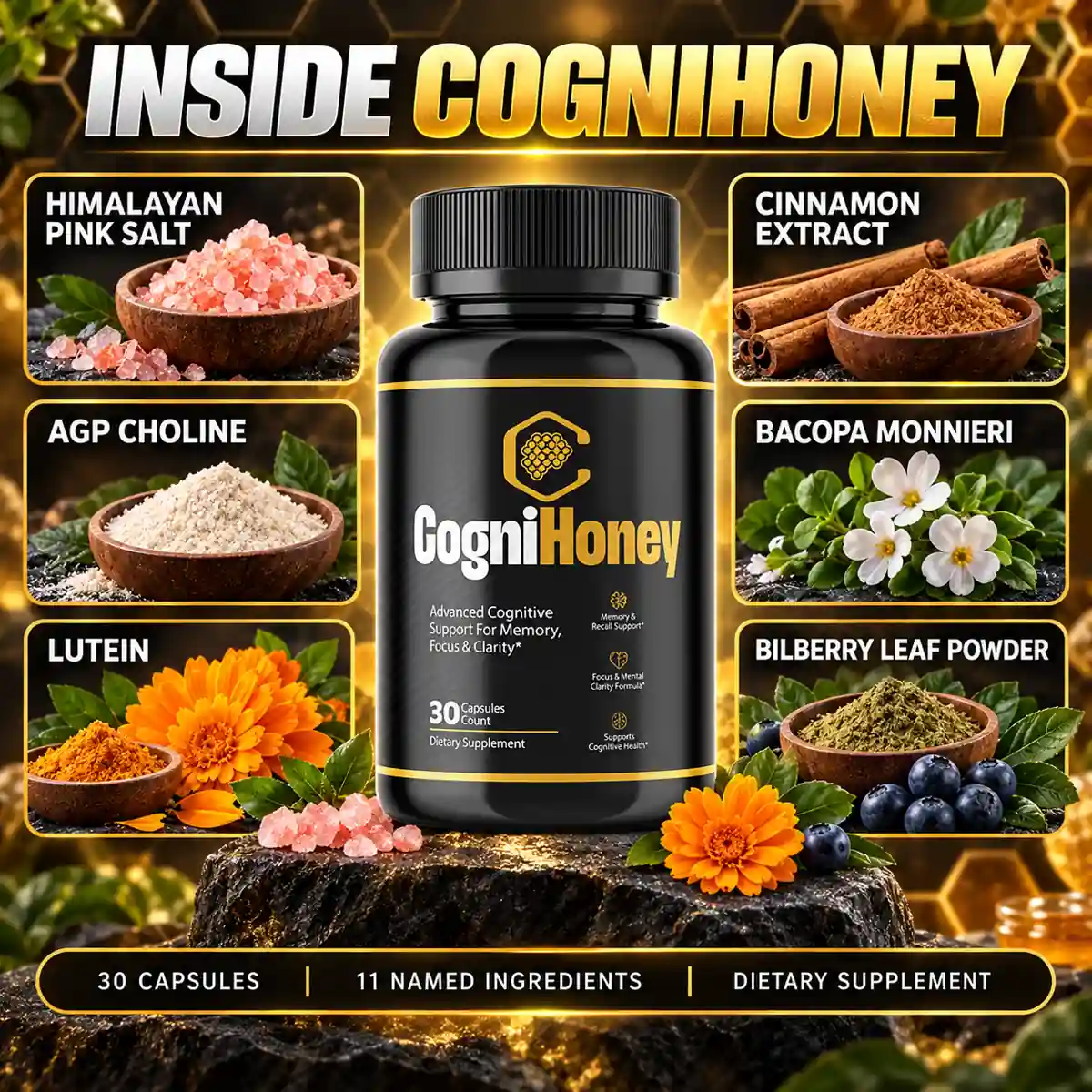
The overlap this note is about even shows up in CogniHoney’s own marketing photography. The “Inside CogniHoney” image, which pictures six of the eleven named ingredients in bowls around the bottle, shows bilberry leaf powder as a bowl of powder pictured beside whole bilberries — the fruit, sitting next to the leaf, in the same frame. It is a natural way to style a photograph of a plant, and it is not inaccurate to show what the plant looks like as a whole. But it is also exactly the kind of juxtaposition that blurs leaf and fruit in a shopper’s mind, which is the confusion this article exists to clear up.
NCCIH’s caution on the leaf specifically
The National Center for Complementary and Integrative Health keeps a public fact sheet on bilberry that draws the same leaf-versus-fruit line this note has been drawing. It states plainly that there is little rigorous research on bilberry leaf for any condition, and separately cautions that bilberry leaf may be unsafe in high doses or when used for a long period, a caution the fact sheet does not extend to the fruit in the same way.[NCCIH] CogniHoney’s own supplement facts page already cites this fact sheet for exactly that reason, and the 2026 leaf-extract study above, with its own toxicity flag at higher doses, is a modern echo of the same caution rather than a contradiction of it. Reading the fact sheet's leaf and fruit sections side by side is a quick, independent way to check any bilberry-based claim against a source that has no reason to favor one plant part over the other.
CogniHoney is a dietary supplement, not a medicine, and nothing here is medical advice. No cognition trial of bilberry leaf powder exists in the PubMed-indexed literature reviewed for this article, and the research above did not test humans. Anyone managing blood sugar with medication should talk to a prescriber before adding any bilberry-containing product.
A checklist for reading “leaf” vs “fruit” on any label
- Read the exact plant part named — leaf, fruit, root and bark can each carry entirely different research.
- Check whether a cited study used the same plant part as the one on the label in front of you.
- Do not assume a plant’s best-known reputation, like bilberry and eyesight, transfers to every part of that plant.
- Look for a public fact sheet, such as NCCIH’s, that treats leaf and fruit uses separately rather than as one entry.
- Read the full supplement facts panel on the bottle you receive, not only the marketing photography.
Sources cited in this article
- Canter PH, Ernst E. Anthocyanosides of Vaccinium myrtillus (bilberry) for night vision--a systematic review of placebo-controlled trials. Surv Ophthalmol. 2004;49(1):38-50. PMID 14711439. https://pubmed.ncbi.nlm.nih.gov/14711439/
- Ulbricht C, Basch E, Basch S, Bent S, Boon H, Burke D, Costa D, Falkson C, Giese N, Goble M, Hashmi S, Mukarjee S, Papaliodis G, Seamon E, Tanguay-Colucci S, Weissner W, Woods J. An evidence-based systematic review of bilberry (Vaccinium myrtillus) by the Natural Standard Research Collaboration. J Diet Suppl. 2009;6(2):162-200. PMID 22435415. https://pubmed.ncbi.nlm.nih.gov/22435415/
- Živković J, Ristić S, Petričević S, Alimpić Aradski A, Ramirez-Ortiz J, Olivero Verbel J, Šavikin K. Modulation of Glycemic Control by Vaccinium myrtillus Leaf Extract: Impact of Inulin Co-Administration. Foods. 2026;15(5):903. PMID 41829175. https://pubmed.ncbi.nlm.nih.gov/41829175/
- National Center for Complementary and Integrative Health, National Institutes of Health. Bilberry. https://www.nccih.nih.gov/health/bilberry
CogniHoney: eleven named ingredients, two capsules a day
Packs of 2, 3 or 6 bottles, and 60 days from purchase to ask for a refund.
$49 to $79 a bottle across the 2, 3 and 6 bottle packs · 60 days from purchase to ask for a refund
Lot COG-26/CO-2321 · ships from the US with tracking · order support +1 (302) 200-3480